Friday, April 15, 2016

East Austin Garden Fair- tomorrow, Saturday, April 16th

Come to a great garden fair - Rain or Shine!
Saturday - April 16, 9:00 am – 2:00 pm 

Parque Zaragoza Recreation Center - Gymnasium 

2608 Gonzales Street, Austin, TX 78702
 
Free: Admission, Plants (vegetables & herbs), Garden buckets, Garden books/magazines and soil screening for food gardeners. Easy instructions for soil sampling at http://austintexas.gov/soilkitchen
 
Visit with friendly gardeners regarding:
  • Bee Keeping, Backyard Chickens, Bugs & Butterfly Gardening
  • Growing Fruit, Citrus, Vegetables & Herbs
  • Preserving Your Harvest & Food Safety
  • Lawns, Turfgrass & Tree Care
  • Drip Irrigation Methods & Rainwater Harvesting
  • Straw-bale Gardening, Grow Boxes & Keyhole Gardens
  • Firewise Landscaping & Native and Adapted Plants
  • Composting Basics & Worm Composting
  • Houseplants, Terrariums, Greenhouses & Hoophouses
  • Aquaponics, Community Gardens & Bio-intensive Methods
  • Caring for Garden Tools & much more!
  
Kids will have a great time with 20 activities on bugs, birds, bees, butterflies, seeds, herbs, leaves, soils and seeing nature up close. Get an apron and build a tool box at the Home Depot Kid's workshop.
 
For more information, please call 512-854-9600
http://aggie-horticulture.tamu.edu/travis/local-extension-resources/east-austin-garden-fair/ 

Friday, April 1, 2016

Webinar on pollinators

2016 All Bugs Good and Bad Webinar Series: Help pollinators cope with pesticides

Webinar TODAY! Friday, April 1, 2016 for the All Bugs Good and Bad Webinar Series: Help pollinators cope with pesticides

Friday, April 1 at 1:00 pm Central


Pollinating insects are at risk when pesticides are used carelessly. Learn practical tips for preventing pollinator deaths from pesticides by Jack Rowe, Dr. James Tew, Sallie Lee, and Dani Carroll from the Alabama Cooperative Extension System. Moderated by Mallory Kelley, Denise Heubach, and Ellen Huckabay, Regional Extension Agents, Alabama Cooperative Extension System. Click here to login as a guest and participate in the live event.   Note: on April 1, the link to the live webinar opens about 15 minutes before the webinar. If you try to log in earlier, you will get an error message.

Don't panic if you cannot login today at 1PM. The webinar will be recorded so you can watch it later.

Friday, March 18, 2016

Mothballs

I remember walking into my great-grandmother's house when I was a little girl and there was...well....there was a smell. Unfortunately for me, it wasn't homemade cookies baking in the oven. I never knew exactly what it was at the time, but years later I discovered that the smell was mothballs. Since the smell of mothballs permeated throughout my great-grandmother's house, she was not using them in a proper manner. I think many people may not know exactly how to use mothballs properly, hence my writing this particular blog post.
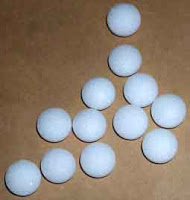
mothballs

First off, please understand that mothballs are a PESTICIDE and can be harmful if not used according to label instructions. Mothballs contain napthalene (I made napthalene in a college chemistry class as one of our laboratory experiments) or paradichlorobenzene as the active ingredient. Both products are fumigants, or volatile chemicals that vaporize at lower temperatures (i.e. room temperature). While "mothballs" is a common term that most are familiar with, these fumigants may also come in the form of cakes, crystals, tablets, bars, among others.

To use the products properly, they should be used in an AIRTIGHT space, such as a well-sealed container, garment bag, etc. They should not be placed in an open container, in a closet or attic, or sprinkled willy-nilly throughout the home (hello great-grandma!). As with all pesticides, you should read and follow all label instructions.  All pesticides, including mothballs, should be kept out of reach of children and pets (mothballs can be mistaken for candy, so this is really important).