My neighbor asked me why her squash seemingly died overnight.
Unfortunately, I had to tell her about squash vine borers (SVB). If you
grow squash in Central Texas, you are most likely familiar with this
insect and it's damage. If you have not yet had the pleasure of
encountering SVB, either lucky you or welcome to Texas or welcome to
vegetable gardening!
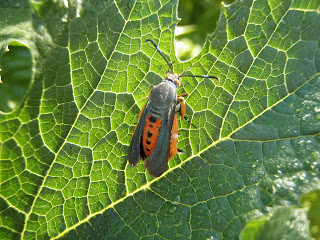 Squash vine borer refers to a moth that lays
reddish-brown eggs singly on the base of squash plants. When the eggs
hatch, the larvae bore into the squash stem where they feed on the plant
from the inside. So if the insect is on the inside of the plant, how
can you tell if that's the problem? Typically, there is a hole in the
stem where the larvae entered which has yellow sawdust-like frass coming
out of it. Larvae overwinter in the soil, pupate, then emerge as adults
in the spring to mate and lay eggs. Adult moths are about half an inch
long with bright, contrasting colors. The abdomen is bright orange with
black dots. The front wings are a greenish-black color and the hind
wings are clear, but you typically don't see the hind wings as the wings
are folded over the back when at rest. Damage is death of the squash
vine. Usually it starts at the base of the plant and moves towards the
outer parts.
Squash vine borer refers to a moth that lays
reddish-brown eggs singly on the base of squash plants. When the eggs
hatch, the larvae bore into the squash stem where they feed on the plant
from the inside. So if the insect is on the inside of the plant, how
can you tell if that's the problem? Typically, there is a hole in the
stem where the larvae entered which has yellow sawdust-like frass coming
out of it. Larvae overwinter in the soil, pupate, then emerge as adults
in the spring to mate and lay eggs. Adult moths are about half an inch
long with bright, contrasting colors. The abdomen is bright orange with
black dots. The front wings are a greenish-black color and the hind
wings are clear, but you typically don't see the hind wings as the wings
are folded over the back when at rest. Damage is death of the squash
vine. Usually it starts at the base of the plant and moves towards the
outer parts.
If you have had squash vine borers infest
your squash, vines should be removed and destroyed (not composted unless
you are sure your compost pile temperature reaches high enough to kill
insects) soon after squash harvest. Soil can be tilled before planting
to reduce the number of larvae that are in the soil. Row cover can be
used to protect new crops of squash you may plant, just remember to
remove the row cover when the squash has blooms to allow pollination to
occur (or hand pollinate). If you leave the squash uncovered, monitor
the stems regularly for eggs and squish the eggs before larvae emerge.
You
can also try to remove the borer from the stem before too much damage
occurs if you catch the infestation early enough. Slit the stem
lengthwise with a sharp knife, remove the borer and then cover the cut
stem with moist soil and hope it takes root. Some people may have
better luck with squash varieties that root wherever they touch the
ground.
On another note, have you been tuning in for the All
Bugs Good And Bad FREE webinar series? If you missed one (or all for
that matter), you can still listen and get great information!
Here's a link to all of the webinars for 2015.
http://www.extension.org/pages/72197/2015-all-bugs-good-and-bad-webinar-series#.VY2DlFJCjV9
For
the webinars that have already occurred, you can click on the topic you
are interested in learning more about and it will load that
presentation page. At the top right corner there is a "watch recording"
button. Click on that and you will be able to listen to the webinar.


 Posts
Posts


