Friday, April 1, 2016

Webinar on pollinators

2016 All Bugs Good and Bad Webinar Series: Help pollinators cope with pesticides

Webinar TODAY! Friday, April 1, 2016 for the All Bugs Good and Bad Webinar Series: Help pollinators cope with pesticides

Friday, April 1 at 1:00 pm Central


Pollinating insects are at risk when pesticides are used carelessly. Learn practical tips for preventing pollinator deaths from pesticides by Jack Rowe, Dr. James Tew, Sallie Lee, and Dani Carroll from the Alabama Cooperative Extension System. Moderated by Mallory Kelley, Denise Heubach, and Ellen Huckabay, Regional Extension Agents, Alabama Cooperative Extension System. Click here to login as a guest and participate in the live event.   Note: on April 1, the link to the live webinar opens about 15 minutes before the webinar. If you try to log in earlier, you will get an error message.

Don't panic if you cannot login today at 1PM. The webinar will be recorded so you can watch it later.

Friday, March 18, 2016

Mothballs

I remember walking into my great-grandmother's house when I was a little girl and there was...well....there was a smell. Unfortunately for me, it wasn't homemade cookies baking in the oven. I never knew exactly what it was at the time, but years later I discovered that the smell was mothballs. Since the smell of mothballs permeated throughout my great-grandmother's house, she was not using them in a proper manner. I think many people may not know exactly how to use mothballs properly, hence my writing this particular blog post.
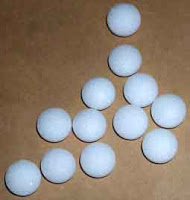
mothballs

First off, please understand that mothballs are a PESTICIDE and can be harmful if not used according to label instructions. Mothballs contain napthalene (I made napthalene in a college chemistry class as one of our laboratory experiments) or paradichlorobenzene as the active ingredient. Both products are fumigants, or volatile chemicals that vaporize at lower temperatures (i.e. room temperature). While "mothballs" is a common term that most are familiar with, these fumigants may also come in the form of cakes, crystals, tablets, bars, among others.

To use the products properly, they should be used in an AIRTIGHT space, such as a well-sealed container, garment bag, etc. They should not be placed in an open container, in a closet or attic, or sprinkled willy-nilly throughout the home (hello great-grandma!). As with all pesticides, you should read and follow all label instructions.  All pesticides, including mothballs, should be kept out of reach of children and pets (mothballs can be mistaken for candy, so this is really important).

Friday, March 4, 2016

Insects on Mountain Laurel

The mountain laurels are in bloom in Central Texas.  This is the time of year I walk around and any time I see a mountain laurel I take in a long, deep breath.  I LOVE the smell when mountain laurels are blooming.  It puts me in mind of grape bubble gum.

So while I enjoy the scent and beauty of the mountain laurel flowers, some people may be more concerned with insects they are finding on their mountain laurels.  The two common insects that I get questions about are the Red Mountain Laurel Mirid (mirids are plant bugs) and the Genista caterpillar.

Red mountain laurel mirids, Lopidea major, are quite stunning.  They are smallish, flattened, oval-shaped bugs that are a striking red and black.   These insects have piercing-sucking mouthparts that they use to feed on plant juices.  While the feeding can cause damage to the leaves- often disfiguring new growth- they do not seem to harm the tree overall.

Genista caterpillars are yellow-green with black and white spots.  They can grow to about 1 inch in length and will spin webbing on the mountain laurel.  The larval (caterpillar) stage has chewing mouthparts and is damaging by feeding on foliage.

For management, treat as needed.  You can try a contact insecticide on the mirids while a Bt kurstaki or spinosad product should work for the caterpillars.